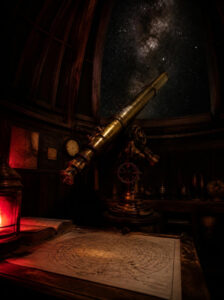
The observatory has, sadly, been in lock-down. Fully entrenched in a heavy monsoon season due to a Super el Nino this year, there has been little chance for observing even the most notable of night-viewing events. Even the September lunar eclipse was blocked from view by the cloud-cover. Although the rain has been welcome for refreshing the desert landscape and for desert gardening, it has prevented Dr. Mike from being able to gather the research data critical for ongoing projects.
Astronomy requires dark, clear skies
In 2021, Dr. Mike and I moved to the high altitude (7500′) desert of New Mexico, home of the darkest skies in the country with the least amount of prohibitive weather. This combination yields the greatest number of clear nights for astronomy and the ability to view dim objects.
After our move here we first took on the project of building the observatory. That is a story in and of itself, with a number of setbacks and overcoming challenges to get to a finished building with bays for 5 telescopes. (I’ll document that in another post.)
With the building completed and 3 scopes in action, Dr. Mike is conducting research for AAVSO as a citizen scientist. AAVSO is the American Association of Variable Star Observers and more information can be found on their website: https://aavso.org.
The AAVSO is dedicated to advancing science by observing and analyzing variable stars. By carefully tracking how a stars change over time, astronomers can learn important details about the star’s properties—such as its size, temperature, mass, and internal structure—and how it changes over its lifetime.
Variable stars are especially important because they act like “cosmic laboratories.” They help scientists test and improve our understanding of how stars work, how they are born, how they evolve, and sometimes how they eventually die. In some cases, variable stars also serve as reference points for measuring distances in the universe, which helps us understand the distances between galaxies and the expansion of space itself.
Variable Stars research
In a nutshell, the research gathered at our observatory is on extremely dim stars called cataclysmic variable stars. This means their brightness varies, producing a light curve, due to being locked in orbit with another star. One star is a “donor” and the second, the “receiver,” is usually a white dwarf. These binary stars produce a measurable light curve and these curves have short periods often measured in hours.
Dr. Mike collects data on one particular star over many nights and then uploads that data into global databases that are then used by both professionals and students. In addition to the AAVSO database, he also provides data for Kent University in England and in 2024, the AAVSO presented Mike with an award for the quantity of data provided to the AAVSO for contributing over 10,000 observations.
Co-authorship
In a highlight of our summer, we received a grateful email from a student in Indonesia working on his thesis. Due to inclement weather there, he was not able to view the star of his thesis (pun intended) but was able to use the research from our observatory posted to the global database to complete his work. Mike Shade will be given co-authorship on the thesis and is looking forward to receiving a copy.
In spite of our inability to operate due to our own weather, the uploaded data provided what was useful to this student, and the work of scientific research carried on.
Dr. Mike also has a library of beautiful astrophotography including galaxies and nebulae, and we will be highlighting some of these features of the universe in future posts.
Remote Hosting Available
I mentioned that the observatory was built for 5 telescopes, and that we have 3 scopes in play. That leaves 2 bays open which are available to rent for remote observing. If you or someone you know is interested please reach out for details.
Leave a Reply